Khamis, 19 April 2012

How Fresh The Air Freshener?

How FRESH Your Air Freshener?
Are They GOOD For Health??


Air freshener chemicals have been implicated in cancer, neurological damage, reproductive and developmental disorders, and other conditions. The synthetic chemicals in air fresheners also can aggravate asthma and/or trigger attacks. Researching air freshener/plug-in ingredients from their Material Safety Data Sheets we find that these ingredients are toxic.

Read More : http://www.mcs-america.org/airfresh.pdf


Many air fresheners employ carcinogens, volatile organic compounds and known toxins such as phthalate esters in their formulas. A Natural Resources Defense Council (NRDC) study of 13 common household air fresheners found that most of the surveyed products contain chemicals that can aggravate asthma and affect reproductive development. The NRDC called for more rigorous supervision of the manufacturers and their products, which are widely assumed to be safe


Read More : http://en.wikipedia.org/wiki/Air_freshener


Look at the packaging of air freshener products and you will see that no ingredients are listed. Thus consumers are unable to decide whether the product they are buying and that they, their children and their babies are breathing is safe or not.


Read More : http://www.squidoo.com/air-fresheners


Car deodorizers have allergens that can cause some people to experience symptoms like headaches or eye irritation. These conventional fresheners also contain toxic chemicals like petroleum distillates, which can irritate or damage your lungs; phthalates, which can interfere with hormone production; and benzene compounds, which have been found to be carcinogenic, according to the Children's Environmental Health Network, a nonprofit Washington, D.C.-based consumer safety organization.

Read More : http://www.examiner.com/article/car-air-fresheners-are-they-toxic


Air fresheners have become a staple in many American homes and offices, marketed with the promise of creating a clean, healthy, and sweet-smelling indoor atmosphere. But many of these products contain phthalates (pronounced thal-ates)—hazardous chemicals known to cause hormonal
abnormalities, birth defects, and reproductive problems.

Read More : http://www.nrdc.org/health/home/airfresheners/fairfresheners.pdf


Studies involving rat and human subjects have suggested that high exposures to certain kinds of phthalates can cause cancer, developmental and sex-hormone abnormalities (including decreased testosterone and sperm levels and malformed sex organs) in infants, and can affect fertility.

Read More : http://www.time.com/time/health/article/0,8599,1664954,00.html


The Material Safety Data Sheet for the air freshener indicated that there was a potential for toxic effects in humans. The air freshener used in the study did not diminish the effect of other pollutants tested in combination. The results demonstrated that the air freshener may have actually exacerbated indoor air pollution via addition of toxic chemicals to the atmosphere.

Read More : http://www.ncbi.nlm.nih.gov/pubmed/9541364


With strong links to phthalates and formaldehyde, it's not surprising that a study that was recently published in the American Journal of Respiratory and Critical Care Medicine indicates that regular use of sprays can increase your risk of developing asthma by 30 to 50 percent. This study was performed by the European Community Respiratory Health Survey, and collected data from 3,500 people in 10 European countries.


Read More : http://drbenkim.com/dangers-air-fresheners.html


Neither the FDA nor the EPA conducts any safety testing or spot checking of toxic chemicals in air freshener products. Essentially, consumers could be exposed to any number of toxic airborne chemicals from air freshener products, with no warning whatsoever. The safety of chemicals used in these products is utterly ignored by the FDA in much the same way that perfumes and cosmetic products containing cancer-causing chemicals are routinely ignored by the agency.

Read More : http://www.naturalnews.com/022067.html


Our gym installed plug-in air fresheners designed to spray a mist of "air freshening" chemicals periodically.  One of them was attached near the ceiling, on a wall that was directly behind all of the treadmills, to ensure that those under the most physical stress, and those breathing the heaviest, would find themselves inhaling a massive blast of chemicals.  Did we mention that these things impair lung function to cause extreme shortness of breath, and potentially heart attacks?  These things are exactly what need to be placed above treadmills.

We experienced immediate difficulty in breathing when running the treadmills, despite all of us being in excellent condition.  We later experienced chest pains and other symptoms of heart problems in unison.  We decided that this madness could not continue any longer.  This article is comprised of our research efforts in pinning down the problem.

Read More : http://healthwyze.org/index.php/how-air-fresheners-are-killing-you.html


Who doesn't love that factory fresh "new car smell"? It's so well-liked that air fresheners and sprays have been produced in attempts to reclaim the odor.

But according to a new study from the nonprofit Ecology Center and HealthyStuff.org, what you might actually be sniffing are toxic fumes from chemicals used to create the car interior.

"Research shows that vehicle interiors contain a unique cocktail of hundreds of toxic chemicals that off-gas in small, confined spaces," Jeff Gearhart, research director at the Ecology Center, said in a written statement. "Since these chemicals are not regulated, consumers have no way of knowing the dangers they face. Our testing is intended to expose those dangers and encourage manufacturers to use safer alternatives."


Read More : http://www.cbsnews.com/8301-504763_162-57378591-10391704/new-car-smell-is-toxic-study-says-which-cars-are-worst/

The Solution Is Here

Sabtu, 16 April 2011

Rise of the Planet of the Apes


Rise of the Planet of the Apes is a 2011 American science fiction film. The film is to be directed by Rupert Wyatt. This will be a new film in the Planet of the Apes series.

James Franco is set to play a scientist working on a cure for Alzheimer's by testing on apes. When test subject Caesar suddenly begins to mutate rapidly, the scientist takes him home to remove him from the cruel lab doctors.

Starring :
James Franco (Harry Osborn / New Goblin = Spiderman, Aron Ralston = 127 Hours) 
Freida Pinto (Latika = Slumdog Millionaire)
John Lithgow (Dick Solomon = 3rd Rock from the Sun)
Andy Serkis (Gollum = LOTR, The Hobbit)
Tom Felton (Draco Malfoy = Harry Potter)
Brian Cox (William Stryker = X Men 2)
David Hewlett (Dr. Rodney = SG1, SG Atlantis)


Filming:
Filming began in July 2010 in Vancouver, British Columbia, Canada. Filming also headed to San Francisco, California (main setting), and around O'ahu, Hawaii.

Special effects:
Unlike previous films in the series, the apes in the film will be created digitally using CGI technology, by Weta Digital.

Release:
The film is set to be released on August 5th 2011. 


Order of films:
1. Planet of the Apes 1968
2. Beneath the Planet of the Apes 1970
3. Escape from the Planet of the Apes 1971
4. Conquest of the Planet of the Apes 1972
5. Battle for the Planet of the Apes 1973

Remake:
1. Planet of the Apes 2001

Prequel:
1.Rise of the Planet of the Apes 2011


Trailer


Source 1

Source 2

Rabu, 13 April 2011

Inventions by Kids

by Cindy Perman

Monday, April 11, 2011

Most kids are creative -- they color and make up games -- but some kids use their creativity to invent new products.


"Kids are natural innovators," said Jon Dudas, who used to work for the U.S. Patent & Trademark Office but is now the president of FIRST, an organization designed to help foster innovations by kids in science and technology.

Dean Kamen, the founder of FIRST and the inventor of the Segway personal transporter, got his first patent when he was 17 for an insulin pump. "His mom had to sign the papers!" Dudas said.

One of the youngest inventors, Dudas recalls, was just two. "Her parents had sort of sectioned off a place where she couldn't open the cabinet doors. She used suction cups and an extension," Dudas explained. "Her parents thought it was a neat idea -- to use for people in wheelchairs with limited movement," he said. She had a patent by age 4!

Kids have been inventing things for hundreds of years and now, thanks to organizations like the Liberty Science Center, FIRST and By Kids, for Kids they're feeling more inspired and more confident to invent. And, turning their products into sales is becoming more of a reality.

Here are 5 cool and inspiring inventions by kids.


Smart Wheel
The Inventioneers are a group of six teens from Londonderry, N.H., and, while some of them can't even drive yet, they've invented a device to help curb distracted driving.

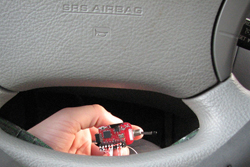
It's called the Smart Wheel and it stands for "Safe Motorist Alert for Restricting Texting, Tweeting, Typing, Touch screens, and Touch ups," said Tristan "T.J." Evarts, a 15-year-old member of the Inventioneers. It's basically a cover for your steering wheel with sensors and LED lights that determines when you don't have both hands on the wheel.

The kids, winners in First Robotics' "First Lego League" competition for several years running, have a provisional patent on the device, one of four patents the teens hold on various inventions.


Sometimes inventions by kids are amazing technological innovations and sometimes they're just plain practical ideas that make you wonder, "Why didn't I think of that?"

The Popsicle , that staple of summer, was created in 1905 by 11-year-old Frank Epperson -- by accident! Epperson had left a mixture of powdered soda, water and a stick in a cup on his porch overnight -- and it was a cold night. He woke up the next morning and it was a frozen treat on a stick.

He initially called it the "Epsicle," which was quite popular with the other kids at school and later his own kids. They kept asking for "Pop's 'sicle" and that, Jimmy, is how the popsicle was born. He got a patent on it in 1923 and then sold the rights to a bigger company. Today, the brand is owned by Unilever and they sell more than two billion Popsicles every year.

Here's another fun fact: The double popsicle was invented during the Depression so two children could share it and it would only cost one nickel.


Makin' Bacon
One Saturday morning in 1991, eight-year old Abbey Fleck was making bacon with her dad. They'd run out of paper towels, so he put it on the classified section of the newspaper. Mom wasn't too pleased, prompting dad to growl, "I could just stand here and let it drip dry."

Ding! Young Abbey thought if they could make a rack to hang the bacon, with a dish underneath, they'd never need paper towels. And so, the Makin' Bacon Dish for cooking bacon in the microwave was born. Not only does it save on paper towels, it's healthier because the grease drips out.

Today, the Makin' Bacon dish costs less than $10 and is sold in Walmart stores -- next to the microwaves. Abbey is now 27 and lives in Los Angeles where she works with special children. She's married to a man who sells the Deflecktor, fuel-saving wheel covers for trucks, that her dad invented.


Wristies

Don't you just hate when you're outside and, even though you're wearing mittens, the snow gets down the sleeve of your coat? 

Most of us just complain about it but one winter's day, 10-year-old KK Gregory was outside building a snow fort and decided to do something about it. She created the first pair of Wristies, a fingerless glove that goes halfway up your arm, keeping your wrists warm and dry. You can wear them with or without mittens. 

Wristies were a hit with her Girl Scout troop, so she decided to get a patent and start her own company. Today, they're sold in select stores, on Amazon.com and on Wristies.com.


Ear Muffs
Speaking of things that warm you up, ear muffs were also invented by a kid.

The year was 1873 and 15-year-old Chester Greenwood was testing out a pair of ice skates. He was getting frustrated because his ears were so cold. He tried wrapping his head in scarf but it was too bulky and too itchy. So, he took wire and bent it into two round loops, then asked his grandmother to sew fur on them. He connected them with a steel headband and got a patent on his invention -- Greenwood's Champion Ear Protectors.

He sold a ton of them to U.S. soldiers during World War I. To this day, Greenwood's hometown, Farmington, Maine, is known as the Ear Muff Capital of the World. They even have a parade every December to celebrate his birthday -- and his invention.

By the time he died in 1936, Greenwood had more than 100 patents, including a tea kettle, an advertising match box and a steel-tooth rake. "There truly was a lot more to Chester than just being the inventor of ear protectors," wrote Nancy Porter, a volunteer with the Farmington Historical Society.

Source


Selasa, 5 April 2011

Video: Recreating Ken Block's Gymkhana... in a Gulf-livery semi truck

Video: Recreating Ken Block's Gymkhana... in a Gulf-livery semi truck

by Aaron Richardson (RSS feed) on Apr 1st 2011 at 12:30PM

Mike Ryan has won a dozen Pikes Peak Hill Climbs in his Gulf-liveried Freightliner Cascadia, so it's no joke when we say this man has some serious talent. To raise his and the truck's profile a little bit, Ryan has decided to show off what he does when he's not storming mountains to stay sharp.

Aping Ken Block's Gymkhana series, Ryan haunts abandoned airstrips, looking for cones, old hangars and dirt roads on which to slide his truck around. In fact, Ryan has gone so far as to shoot this video at El Toro, the same Marine air base where Block filmed the first installment of his epic videos.

Ryan's Freightliner packs 1,950 horsepower and more than 3,400 pound-feet of torque, so roasting the truck's handmade custom Michelin tires isn't a problem, even in a 10,000-pound Big Daddy Freightliner. 

Check out all the action in HD splendor after the jump. Top tip, Jason!


Source

Isnin, 28 Mac 2011

Japanese repair quake-ravaged road in just six days


by Chris Shunk (RSS feed) on Mar 24th 2011 at 12:30PM

6 Days Before


Due to the extensive damage in Japan caused by the massive earthquake and resultant tsunami on March 11, many have questioned if the island nation can recover in a year, much less a few months. If the swiftness with which the Japanese can repair roads is any indication, we wouldn't bet against the country cleaning up this catastrophe in short order.

As a result of the quake, a 150-meter section of the Great Kanto Highway in Naka was absolutely obliterated, with massive chasms running right through the middle of the road.Work crews at the NEXCO road repair company sprang into action on March 17, working at a fevered pitch to help get their country on the road to recovery, literally. Amazingly, after only six days of labor, the road is silky smooth and ready for travel. Look at the the before and after photos above to see just how amazing this feat is.

Given the fact that road crews in the U.S. can spend three or more months repairing a single lane of concrete, only to leave the orange barrels on the road for another two weeks, we're blown away by this feat of engineering. Simply amazing.

After


Source

Ahad, 27 Mac 2011

Biometric wallet is 'virtually indestructible,' opens with your touch


By Jeffrey Van Camp, DigitalTrends.com

This biometric wallet has a Bluetooth proximity alarm, carbon fiber shell, and fingerprint sensor for maximum security. It will set the rich and paranoid back about $825. 


Afraid someone might take something out of your wallet? If you have $825 to spend, fear no more. Dunhill is selling what it calls a “Biometric Wallet” that it claims is virtually indestructible and can only be opened with your fingerprint. Scared of someone taking the entire wallet? It can be linked to a mobile phone via Bluetooth and set to sound an alarm if your phone and wallet are separated by more than five meters (15 feet).


This wallet is built to be durable. It has a carbon fiber shell, leather interior, and stainless steel money clip. If only its design matched its top-notch construction. Almost any standard wallet looks slicker than this clamshell.


Would you invest more than $800 into a wallet? If so, what features would you require? 


Source

Khamis, 24 Mac 2011

Tomahawk (missile)


The BGM-109 Tomahawk is a long-range, all-weather, subsonic cruise missile. Introduced by General Dynamics in the 1970s, it was designed as a medium- to long-range, low-altitude missile that could be launched from a submerged submarine. It has been improved several times and, by way of corporate divestitures and acquisitions, is now made by Raytheon. Some Tomahawks were also manufactured by McDonnell Douglas (now Boeing Defense, Space & Security).

Description
The Tomahawk missile family consists of a number of subsonic, jet engine-powered missiles for attacking a variety of surface targets. Although a number of launch platforms have been deployed or envisaged, only naval (both surface ship and submarine) launched variants are currently in service. Tomahawk has a modular design, allowing a wide variety of warhead, guidance and range capabilities.


Type = Long-range, all-weather, subsonic cruise missile
Place of origin = United States

Service history
In service = 1983-present

Production history
Manufacturer = General Dynamics (initially) and Raytheon/McDonnell Douglas
Unit cost = Approximately $569,000 (FY99 $) , Approximately $755,851.27 in 2011 dollars.

Specifications
Weight = 2,900 lb (1,300 kg)
Length = Without booster: 18 ft 3 in (5.56 m)
With booster = 20 ft 6 in (6.25 m)
Diameter = 20.4 in (0.52 m)
Warhead Conventional = 1,000 lb (450 kg) Bullpup, or submunitions dispenser with BLU-97/B Combined Effects Bomb, or a 200kt (840 Tj) W80 nuclear device (inactivated in accordance with SALT)

Detonation mechanism = FMU-148 since TLAM Block III, others for special applications
Engine = Williams International F107-WR-402 turbofan
= using TH-dimer fuel and a solid-fuel booster

Wingspan = 8 ft 9 in (2.67 m)
Operational range = 1,350 nautical miles (2,500 km)
Speed = Subsonic - about 550 mph (880 km/h)

Guidance system= GPS, TERCOM, DSMAC

Launch platform = Vertical Launch System (VLS) and horizontal submarine torpedo tubes (known as TTL (torpedo tube launch))


Source 1


Source 2

Jumaat, 18 Mac 2011

NASA Scientist Explains Science Behind 'Supermoon' Phenomenon

This story was updated at 2:25 p.m. ET.
The tragic earthquake and tsunami in Japan Friday (March 11) set the Internet abuzz with the idea that the moon, which will be at its fullest of the year on March 19, played a role in the devastating natural disaster. 
The seed for the idea was planted by an astrologer, who contended that this large full moon – a so-called "supermoon"– would touch off natural disasters like the Japan earthquake since the moon would make its closest approach to Earth in 18 years. Scientists, however, dismissed the notion entirely and now a top NASA scientist is weighing in. [Japan Earthquake and Tsunami in Pictures]
In a statement released Friday, noted NASA scientist Jim Garvin explains the mechanics behind the moon's phases and the causes of the supermoon. Garvin is the chief scientist at NASA's Goddard Space Flight Center in Greenbelt, Md.
"'Supermoon' is a situation when the moon is slightly closer to Earth in its orbit than on average, and this effect is most noticeable when it occurs at the same time as a full moon," Garvin wrote in the NASA statement. "So, the moon may seem bigger although the difference in its distance from Earth is only a few percent at such times." [Photos: Our Changing Moon]
The full moon of March will occur next Saturday on March 19, when the moon will be about 221,567 miles (356,577 kilometers) away from Earth. The average distance between the Earth and the moon is about 238.000 miles (382.900 km).
"It is called a supermoon because this is a very noticeable alignment that at first glance would seem to have an effect," Garvin explained. "The 'super' in supermoon is really just the appearance of being closer, but unless we were measuring the Earth-Moon distance by laser rangefinders (as we do to track the LRO [Lunar Reconnaissance Orbiter] spacecraft in low lunar orbit and to watch the Earth-Moon distance over years), there is really no difference."
It was astrologer Richard Nolle who linked the full moon of March 19 to natural disasters. He claimed that this "supermoon" would trigger massive earthquakes, volcanoes and powerful storms when it arrived.  But scientists assure that this is not the case. ['Supermoon' Did Not Cause Japan Earthquake and Tsunami]
Garvin, for example, said the moon's effects on Earth have been the subject of extensive studies.
"The effects on Earth from a supermoon are minor, and according to the most detailed studies by terrestrial seismologists and volcanologists, the combination of the moon being at its closest to Earth in its orbit, and being in its 'full moon' configuration (relative to the Earth and sun), should not affect the internal energy balance of the Earth since there are lunar tides every day," Garvin wrote.
But while the moon helps drive Earth's tides, it is not capable of triggering devastating earthquakes.
"The Earth has stored a tremendous amount of internal energy within its thin outer shell or crust, and the small differences in the tidal forces exerted by the moon (and sun) are not enough to fundamentally overcome the much larger forces within the planet due to convection (and other aspects of the internal energy balance that drives plate tectonics)," Garvin explained.